
Student Teaching
STT 399A02 -- Student Teaching in Art -- Fall 2025
High School Placement
Plainfield North High School, Plainfield IL -- Peter Quimby -- 8/11/2025-10/11/2025
Art Foundations
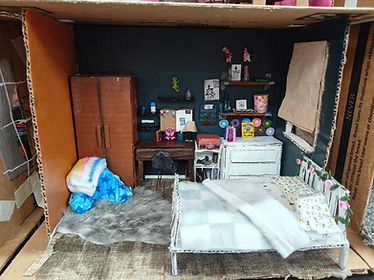
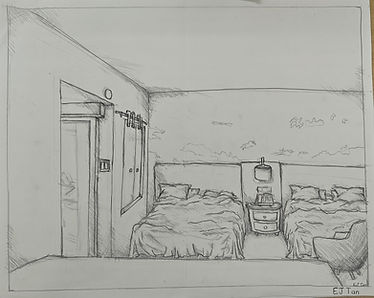
In this multi-day unit, students explore Surrealism and one-point perspective by creating both a three-dimensional diorama and a final perspective drawing. Students begin by investigating emotionally significant rooms from their own lives and analyzing how artists use space, thresholds, and surreal imagery to communicate ideas. Using found materials, they construct a detailed diorama of their chosen room, which becomes a physical reference for their drawing. Throughout the unit, students practice perspective techniques, develop surreal window scenes, and create compositional sketches before combining realism and surrealism in their final artwork.
The unit emphasizes creative experimentation, emotional storytelling, and technical skill-building. Students engage in peer critique, set class-generated evaluation criteria, revise based on feedback, and write an artist statement articulating their visual choices. By the end, students produce a completed diorama, a surreal perspective drawing, and reflective written work that demonstrates their understanding of space, mood, and artistic intention.
Unit Plan Instructional Materials
Student Work






Assessments
Formative
Throughout the unit, students complete analysis worksheets that guide them in examining key artworks, identifying emotional impact, compositional choices, and surrealist elements. These worksheets support students in building vocabulary, practicing visual analysis, and making connections to their own developing ideas. The teacher reviews the worksheets for clarity, depth, and accuracy, using the results to provide targeted feedback and adjust instruction as needed.
Summative
At the end of the diorama construction, students participate in a formal class critique where they present their completed diorama. Using the class-created criteria, peers offer constructive feedback on craftsmanship and emotional communication. Students articulate their artistic decisions and reflect on their work publicly. This critique serves as the final evaluation of their understanding of the unit’s concepts, technical skills, and ability to communicate meaning through visual art.
Middle School Placement
John F. Kennedy Middle School, Plainfield IL -- Elizabeth McGovern -- 10/11/2025-12/05/2025
6th Grade
In this unit, 6th grade students explore the element of value and the stylistic qualities of Cubism by creating a Cubist animal composition. Students begin by learning how value works and practicing creating a full range of light and dark tones. They then study Cubist artists such as Picasso and Braque, identifying how these artists simplified forms into geometric shapes. Through guided practice, students break down animals into basic geometric structures and experiment with applying solid values to create contrast and visual interest. The unit culminates in a final Cubist drawing of an animal in its natural environment, where students combine simplified shapes with strong value contrasts. Formative assessments—including guided notes, value scales, and practice sketches—support learning throughout, and a completed final composition serves as the summative assessment.
Unit Plan Instructional Materials
Student Work
.jpg)


Assessments
Formative
Throughout the unit, students complete guided notes, value scales, and Cubist practice sketches that serve as formative assessments. These worksheets help the teacher monitor students’ understanding of value, their ability to simplify forms into geometric shapes, and their grasp of Cubist characteristics. The teacher reviews these tasks to provide immediate feedback and adjust instruction as students build the skills needed for their final project.
Summative
For the summative assessment, students create a completed Cubist drawing of an animal in its natural environment, using geometric shapes and solid values to convey depth and interest. The final artwork is evaluated using a rubric that assesses craftsmanship, use of value, application of Cubist techniques, and overall composition. This summative piece demonstrates students’ mastery of the concepts and skills developed throughout the unit.
Professionalism, Advocacy, and Leadership: Pal 1
IPTS (2013) STANDARD 9 - Professionalism, Leadership, and Advocacy - The competent teacher is an ethical and reflective practitioner who exhibits professionalism; provides leadership in the learning community; and advocates for students, parents or guardians, and the profession.
Description
The Illinois art educator association is an annual conference where art educators all over Illinois can convene, and share concepts and ideas.
Rationale
The IAEA conference is useful in regards to the ability for Art teachers to develop panels and explore techniques to further student comprehension and understanding of different mediums.
Evidence

Professionalism, Advocacy, and Leadership: Pal 2
IPTS (2013) STANDARD 9 - Professionalism, Leadership, and Advocacy - The competent teacher is an ethical and reflective practitioner who exhibits professionalism; provides leadership in the learning community; and advocates for students, parents or guardians, and the profession.
1
Description
I have an Instagram page dedicated to my artwork and my small business. I use my account to share my art with anyone who comes across my page.
Rationale
Having a page dedicated to my artwork allows me to see how I've grown as an artist since I started the account in middle school.
Evidence

